Description
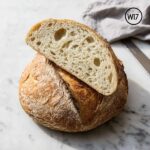
This classic Sourdough Bread Recipe guides you through the art of making a beautifully crusty and airy loaf using traditional sourdough starter. With detailed steps including feeding the starter, stretching and folding the dough, bulk fermentation, and a cold proof for enhanced flavor, this recipe produces a rustic loaf perfect for sandwiches, toasts, or simply enjoyed with butter.
Ingredients
Scale
Sourdough Starter and Dough
- 50 to 100 grams ripe bubbly active starter (¼ cup to ½ cup; preferably 100 grams)
- 350 to 375 grams warm water (375 grams recommended; less in humid weather)
- 500 grams bread flour (or all-purpose flour – approximately 4 cups plus 2 tablespoons; preferably organic King Arthur Bread Flour)
- 10 to 12 grams fine sea salt (such as pink Himalayan sea salt)
Instructions
- Feed Your Starter: Remove your starter from the refrigerator the night before and feed it. Feed it again the morning you plan to make your dough or at least a few hours prior. The starter is ready to use when it has doubled in size before shrinking back.
- Make The Dough: In a large mixing bowl, combine the active starter with warm water and sea salt, mixing well. Add the bread flour and mix until a wet, sticky dough forms and the ingredients are fully incorporated. Cover with a damp towel and let rest for 30 minutes at room temperature.
- Stretches and Folds: Using a wet hand, gently pull and fold corners of the dough into the center, rotating around the bowl 4-5 times until the dough forms a ball. Rest covered for 30 minutes. Repeat this folding and resting process 3 more times at 30-minute intervals, covering after each. If time is limited, performing twice is acceptable.
- Rest (Bulk Fermentation): After stretching and folding, cover the bowl with a damp towel and lid to prevent drying and let the dough rise at room temperature for 6-7 hours or up to 8-9 hours if cooler. The dough should increase 50-70% in volume, appear bubbly, and jiggle when shaken.
- Pre-shape: Turn the dough out onto a lightly floured surface. Gently fold the dough into a round shape by tucking the edges toward the center, rotating as you fold. Use a bench scraper if available to create surface tension.
- Bench Rest: Flip the dough ball over and let it rest uncovered for 30 minutes. Then, pull edges towards you to tighten the ball, rotating and repeating to enhance tension.
- Shaping: Prepare a proofing basket by heavily dusting with flour or line a medium mixing bowl with a floured clean towel. Shape the dough into a tight ball again by folding edges to the center, rotate continuously, and place smooth side down into the basket or bowl. Cover with plastic wrap, shower cap, or towel.
- Cold Fermentation (Second Rise): Refrigerate the dough overnight or for 18-24 hours to develop flavor and texture. If baking same day, let dough rest 1-2 hours at room temperature until puffy and spread slightly.
- Baking Preparation: Preheat your oven to 450°F (232°C). Cut parchment paper to fit your Dutch oven.
- Transfer Dough: Gently turn the dough onto the parchment paper. Score the dough’s top with a sharp blade or knife to allow proper expansion during baking.
- Bake Covered: Using the parchment paper, lift and place the dough into the preheated Dutch oven. Cover with its lid and bake at 450°F for 30 minutes.
- Bake Uncovered: After 30 minutes, remove the lid, reduce oven temperature to 400°F (204°C), and bake uncovered for an additional 20 to 30 minutes, or until the crust is deeply browned and the internal temperature reaches 205–210°F (96–99°C).
- Cool: Remove the bread from the Dutch oven and transfer it to a wire rack. Allow it to cool for at least 1 hour before slicing to finish setting the crumb.
Notes
- For best flavor and texture, use the cold fermentation method with overnight refrigeration.
- The quantity of water may vary depending on humidity and flour absorption; adjust to obtain a wet, sticky dough.
- Stretch and folds help develop gluten structure without kneading.
- Use a Dutch oven or heavy covered pot to mimic steam oven conditions for a crisp crust.
- Allow the bread to cool completely before slicing to avoid gummy texture.
- The internal temperature of 205-210°F indicates fully baked bread.
- The amount of starter used can be adjusted between 50-100 grams depending on fermentation time desired.